GIRLS ON PARCHMENT

Medieval poets love to describe the beauty of women in their stories. Their hyperbole has no limits – they claim left and right that the maiden in the story you’re hearing right now has the best nose, mouth and eyes ever formed by God! 

Wait a second, didn’t Enide possess those one-of-a-kind physical features? It’s beginning to look like there’s a Venus on the half shell in every town in Brittany!

This installment of Girls on Parchment comes from Chaucer’s Tale of Sir Thopas. It is one of the shortest Canterbury Tales – measuring at 241 and… err…1/2 lines. It could have been the longest Canterbury Tale ever – had the host Harry Bailey not made Chaucer stop telling it.

The Tale of Sir Thopas is about a knight who quests after the woman of his dreams, an elf-queen. To win her, he must run from an evil giant knight and make his way through the wild jungle of “the contree of Fairye” – while occasionally making pit stops at his castle to enjoy dainty cakes and model new designer sets of armor. After all, he must look his best on his quest! He’s undeniably the blueprint for Monty Python’s Sir Robin.
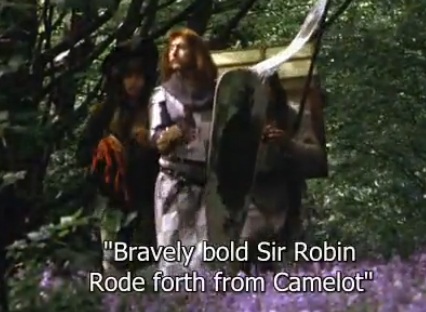
bravely bold sir robin

Sir Robin (played by Eric Idle) from Monty Python and the Holy Grail image copyright 1974 Python (Monty) Pictures / Sony Pictures

And now, “Liseth lordes, in good entent!”

– Oh, and make sure you always sing Chaucer’s Tale of Sir Thopas to the tune of Bob Dylan’s “The Times they are a-changin'” –

here is Chaucer’s description of our tale’s hero:

Sir Thopas wax a doghty swayn,
Whit was his face as payndemayn,
Hise lippes rede as rose;
His rode is lyk scarlet in grayn,
And I yow telle, in good certayn,
He hadde a semely nose.
His heer, his berd, was lyk saffroun (ll. 1914-20)[1]

saffron

Saffron for sale at Philadelphia’s Reading Terminal Market.

This brave knight has a beard like saffron – a soft, yet bristly beard with a complex red aroma. That’s certainly more intimate detail of a knight’s physical features than we usually get in medieval poetry – except for Chaucer’s Squire of course.[2]

Sure, we get endless descriptions of the quality of a knight’s gear, but as far as detailed descriptions of physical features go – the English medieval poet might give us, “he was passing fair” – if we’re lucky – as Malory did for Galahad:

… therin came twelue nonnes that broughte with hem Galahad the whiche was passynge fayre and wel made that vnneth in the world men myghte not fynde his matche…[3] … therin came twelve nuns that brought with them Galahad, the which was passing fair and well made, that unnethe in the world men might not find his match…[4]

But let’s return to Chaucer’s description of Sir Thopas. It continues to describe his outfit – how fashionable and expensive it is:

Hise shoon of Cordewane.
Of Brugges were his hosen broun,
His robe was of syklatoun,
That coste many a jane. (ll.1922-25)

Of clooth of lake, fyn and cleere,
A breech, and eek a sherte (ll.2048-49)

…a fyn hawberk,
Was al ywroght of Jewes werk (ll.2053-54)

His swerdes shethe of yvory (l.2066)

It really goes on and on… shoes made of Cordovan leather, brown socks imported from Belgium. If it was written today, we would need the September issue of Vogue just to follow it. 

Chaucer pays tribute to the masters of French Romance by emulating how they describe luxury clothing and character dwellings in such a way that they seem incredibly expensive, even to an audience of court nobility. 

He emulates the style of Chrétien de Troyes and Marie de France, but does it so well that he doesn’t realize he’s filling his fantasy balloon with so much air that it will burst.[5]

Enough about Thopas. What about the maiden? Our girl on parchment – how beautiful is she? Well, the only description we get of her is, “elf-queen.” That’s it. “Elf-queen.” Not even, “beautiful elf-queen with ears like sweet pointed peppers.”

We get a longer description of the gingerbread cake that was baking at the court of Sir Thopas:

And gyngebreed that was ful fyn,
And lycorys, and eek comyn,
With sugre that is so trye

The host makes Chaucer end this train wreck of a tale before the elf-queen actually appears in the story. Though we’ll never know how Chaucer’s pilgrim would have described the elf-queen’s supreme beauty, at least The Tale of Sir Thopas provides a different sort of girl on parchment.

“That’s enough music for now, lads!”

Click here for another installment of Girls on Parchment


[1] References to Chaucer in Middle English are taken from Chaucer’s Major Poetry, Ed. Albert C. Baugh (New York, 1963).

[2] Sir Thopas resembles the Squire more than the Knight in The Canterbury Tales. I wonder if Chaucer had originally intended the Squire to tell this tale. Also, I wonder how common stories and jokes about “Runway Knights” who could pass as Zoolander were in Chaucer’s day.

[3] Caxton’s Malory in Middle English from Middle English Compendium (Ch. 13, leaf 307r) available online: http://name.umdl.umich.edu/MaloryWks2

[4] Caxton’s Malory in modernized English spelling from Le Morte D’Arthur, Ed. Elizabeth J. Bryan (New York, 1999), p. 656

[5] Is it purely the English making fun of French style? As always, Chaucer gives his work plenty of layers of comedy. On the surface the poem seems simple enough, but it has an absurdly complex structure that is just waiting to topple over itself like a lost game of Jenga. Though the rhymes technically work, they keep surpassing themselves in their corniness. The cringing audience is forced to take action as a barkeeper would do to stop an absolutely terrible karaoke singer 3 minutes into Don McClean’s “American Pie.” For a few laughs from the scribes at Hengwrt and Ellesmere, see Maik Hildebrandt‘s The Layout of “Sir Thopas” http://maikhildebrandt.wordpress.com/2012/10/19/the-layout-of-sir-thopas/

Update July 28, 2013: Consider King Horn, Havelock the Dane, and other 13th century Middle English Romances in addition to or instead of the French Romances. Chaucer may be parodying English Romance specifically and contributing to its popularity by virtue of his parody. After all, it has been argued that “the spirit of English Romance became the spirit of English literature.” It’s also been argued that Chaucer’s parody of English Romance in Sir Thopas is not restricted to the romance lyric or the minstrel style, but “oral performances of all kinds.” Another good article to help us appreciate the reception and physical form of Sir Thopas is: Jessica Brantley, “Reading the Forms of Sir Thopas“, Chaucer Review 47 (2013): 416-38.

the-hobbit-an-unexpected-journey

To celebrate the theatrical release of The Hobbit: An Unexpected Journey, tolde by the weye partnered with Filmhash to post retrospective reviews of Peter Jackson’s film adaptation of The Lord of the Rings:

tolde by the weye reviews The Fellowship of the Ring

Ryan Silberstein reviews The Two Towers

Jill Malcolm reviews The Return of The King

also, Filmhash reviews The Hobbit: An Unexpected Journey

Winters are hard. It’s not quite winter yet, but many of its signs are already here. When I leave for work it’s dark and when I get back home it’s still dark. Philadelphia had its first snow this past Monday. It didn’t really do much, but it was snow. So, when the cold wind blows full force while I’m waiting for the bus, it’s hard to think about much else – except, of course, how miserable people must have been during winter in the medieval world!

Those poor folks probably spent nearly every waking minute of their entire life in moderate to severe physical discomfort.

Anyway, I thought I’d post a Middle English lyric about winter time. It probably brought a little comfort to the rich people in their chilly castles. Who knows, it just might make us warm too:

Here’s an excellent version performed by The Dufay Collective:

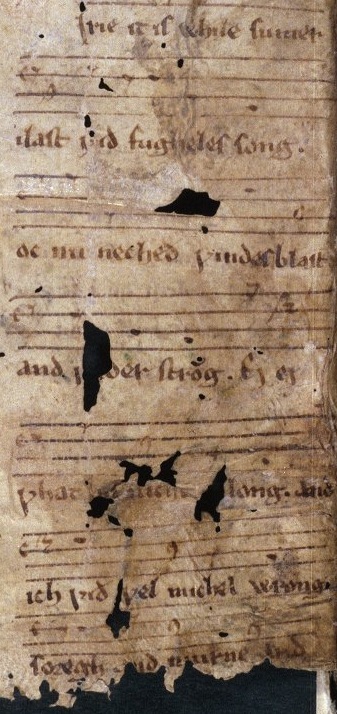
You can follow along on the manuscript below. The text is sung 0:00 – 0:33 and repeated several times ending with a refrain of “soregh and murne and fast.”

miri bodleian

detail of the song as it appears on fol. 001v of Oxford Bodleian Manuscript Rawlinson G. 22 (c. 1225) image: LUNA

Myrie it is while sumer

ylast with fugheles song.

oc nu neheth windes blast

and weder strong. Ei, ei!

what this nicht is long.  and

ich with wel michel wrong

soregh and murne and

fast

Here’s a quick very literal translation to follow it in the Middle English:

Merry it is while summer

lasted and birds sung. (or the bird’s song)

But now the wind’s blast is nigh (or comes close upon us)

And weather strong. Whoa oh

Oh this night is so long. And

I with very much wrong

sorrow and mourn and

fast

The two words that really stand out to me are fugheles and fast. In 14th century Middle English, you usually see fowles instead of fugheles – which I find much easier to pick out as “fowls.” For example, in the opening lines of Chaucer’s Canterbury Tales you have “And smale foweles maken melodye.”

During the warmer months the birds are chirping, there is abundance of food and warmth, however, during the winter we must be more moderate (or fast[1]) and use our store because fresh food is scarce. You have this great contrast of warm/cold, summer/winter, rise/decline, bustling & busy/slow and stagnant, sweet/bitter. Though winter will be long, there’s a kind of harmony in this balance. The suffering is part of a cycle and summer will return.

Things can’t be growing fast and fat all the time. So it might bring some solace to folks freaking out about the fiscal cliff to see our troubled economy as a long dormant period of frosty fields left fallow, waiting to thaw and rise again with renewal and growth? Probably not…


[1] I wrote a little bit about what the Secreta Secratorum says about diet following seasonal cycles in a previous post.

Ramona helps Scott defeat Roxy in Scott Pilgrim vs. the World (image: copyright Universal Pictures 2010)

I watched Scott Pilgrim vs. the World this weekend on Ryan‘s recommendation. It is about a guy who meets the girl of his dreams, but to date her he must defeat her seven evil exes in a video game – for real. It was a silly movie, but one that my wife and I enjoyed.

The film borrows elements from many epic storytelling mediums. Sounds appear on the screen as handwritten words just as they do in comic panels. From the 8-bit charm of the Universal Pictures titles sequence to Scott’s “pee bar” that appears on the screen when he needs to urinate, there are little touches to remind us that we are in a video game as well. 

And, of course, Scott plays bass in a new garage rock outfit; the stories in their songs coolly convey their epic struggle to thrive in the music scene. 

Just as epic poetry points to social struggles, Scott Pilgrim vs. the World provides social commentary by addressing the ever uncomfortable and paradoxical popularity of hipster culture.

But a considerable amount of comical symbolism comes from far older sources, borrowed from epic storytelling and even a medieval text. One part in particular recalls a scene from Das Nibelungenlied (Song of the Nibelgungs). Das Nibelungenlied is a 13th century epic poem in Middle High German. In the poem, Sifried, a prince from the Netherlands, travels to Burgundy to court the woman of his dreams, Krimheld. 

While there, he helps the Burgundian King Gunter defeat the Saxons. King Gunter later decides that the only woman in the world suited to be his wife is Brunhild, an Icelandic queen. 

King Gunter asks Sifried to accompany him to Iceland to “court” Brunhild. Gunter believes that Brunhild is the woman of his dreams, so he attempts to win her hand in marriage. But to do this, he must compete with her in a dangerous game. If he wins the game, he will take Brunhild for his wife. If he loses the game — and no man had ever defeated Brunhild – he will die.

Sifried knows that Gunter cannot possibly win the game, so he quickly devises a plan to help his liege lord win:

They thought to themselves: “This journey    starts to seem like a bad mistake”
No one noticed that noble    Sifried had quietly walked
away from this noisy scene,   gone down to their unguarded ship
and gotten his threefold magic     cloak. Once it was slipped
lightly across his shoulders     he became completely invisible.

And then he hurried back,     joined the crowd of warriors
come to enjoy Brunhild’s    games, in the place she had ordered
made ready. Wrapped in his cloak    he could walk among them, unseen,
surrounded by men who never    suspected his presence, awaiting their queen.[1]

 As Brunhild prepares to throw her first blow, Gunter realizes that he is no match for her:

Quickly, she rolled her sleeves    up her clear white arms,
clasped one hand in her shield,     and then raised her great spear high
in the air. The games were about       to begin. In addition, the look in her eyes
worried Gunter and Sifried.    The king was facing deadly harm.[2]

Sifried comes to the rescue in the nick of time:

 And true enough, without    Sifried’s aid, plainly

Gunter would have been killed.         But Sifried gave the king’s
hand the lightest touch,  making Gunter shrink
away, completely confused. Brunhild was taking careful aim.

“What could have touched my hand?”    Gunter said to himself,
seeing nothing, nor anyone         standing beside him there.
“It’s me, Sifried,” he heard,     “your dearest friend. I’m here
to save you. Have no fear    of the queen, so long as you have my help.

“Quickly, let me have    your shield and let it stay
in my hands. Be careful, do    exactly what I say.
You go through all the motions,    but leave the work to me.”[3]

 When Brunhild’s spear hits the shield, Sifried is hurt, but quickly recovers to return the blow:

Blood came gushing from mighty      Sifried’s mouth. But then
he straightened, wrenched the spear     free of his shield, and threw it,
meant as it was for the king,     hurled it straight at the beautiful
girl with Sifried’s strength          behind it, and back to Brunhild it went.[4]

So, Sifried wins the life-or-death competition for Gunter by moving Gunter’s body and limbs for him. Since Sifried is invisible, no one in the audience can tell that when Gunter leaps, for example, it’s actually Sifried leaping with Gunter on his back. Likewise, when Gunter blocks a blow, it’s really Sifried moving him arms.

The same thing occurs in Scott Pilgrim, albeit played for comic effect — and minus the invisibility part.  One of the evil exes is too much for Scott to handle on several levels, Ramona grabs his fists from behind and helps him win the fight just like Sifried did for Gunter.

It is also an important moment in both stories. Each companion’s true loyalty is shown.

Gunter knew Sifried as a great warrior who fought for fame. He certainly didn’t expect him to fight loyally for him. And for his part, Scott Pilgrim, the hypermodern epic hero, realizes that though he must still fight the evil exes, he and Ramona are already “together.”


[1] Das Nibelungenlied, Trans. Burton Raffel (New Haven, 2006), verses 430-432, p.61

[2] Das Nibelungenlied, verse 451, p.64

[3] Das Nibelungenlied, verses 452-454, p.64

[4] Das Nibelungenlied, verse 458, p.65

Today’s medieval bloodfest comes from La Chanson de Roland (Song of Roland), a 12th century epic poem written in a style the French call chanson de geste (song of heroic deeds). This style of storytelling was popular in France from about the 12th to 15th century.

Chanson de Roland was the Star Wars of its day –Roland and King Marsilla were characters as well-known in 12th century French popular culture as, say, Luke Skywalker and Darth Vader are to Americans now. Except, as we will see from the scenes below, a faithful adaptation of Chanson de Roland would be quite the medieval bloodfest and it couldn’t have possibly received the PG rating that Star Wars did from the MPAA film-rating system in 1977. The level of brutality in the scenes below simply would not be deemed suitable for a popular audience in the late 1970’s. In 1976, Martin Scorcese darkened the red blood to black at the end of Taxi Driver to avoid an X rating from the MPAA, yet something tells me that if these scenes below were reviewed just as they are for the MPAA in 1150, Chanson de Roland would receive a G rating. Oh, how les temps changent!

So, to set the scene for Today’s Medieval Bloodbath, the Saracens are planning their ambush of Roland and the French at the pass at Roncesvalles. And just like good villains from Star Wars or James Bond, they take this opportunity to fantasize about the future success of their plan with their partners in crime. Aëlroth, the nephew of King Marsilla asks the king for the honor of throwing the first blow against Roland during the ambush:

Give me a fief; that is, first crack at Roland
and I shall kill him with my sharpened spear.
provided that Mohammed will protect me,
I’ll set free every bit of land in Spain
from the Spanish passes down to Durestant.” (verses/laisses 860-870)[1]

This big talk earns him the prestigious honor of first crack at Roland.

Over-inflated with pride, Aëlroth shouts even bolder words on behalf of the Saracens when they meet the French on the battlefield:

“French villains, you shall fight with us today,
For he who should protect you has betrayed you;
The king who left you in this pass is mad.
This very day sweet France shall lose her fame,
And Charlemagne the right arm from his body.” (v. 1191-1195)[2]

This little speech motivates Roland to make Aëlroth eat his words right then and there:

He spurs his horse and lets him run all out
and goes to strike the count with all his force;
he breaks his shield and lays his hauberk open
and pierces through his chest and cracks the bones
and cuts the spine completely from the back
and with his lance casts out his mortal soul,
impales him well, and hoists the body up
and throws him dead a spear’s length from his horse.
The neck-bone has been broken into halves,
and still he does not leave, but tells him this:
“You utter coward, Charles is not a fool,
nor has he ever had a love of treason.
His act was brave, to leave us at the pass;
today sweet France is not to lose her fame.” (v. 1197-1210)[3]

For another installment of Today’s Medieval Bloodfest, click here.


[1] The Song of Roland trans. Robert Harrison, (New York, 1970), 78.

[2] The Song of Roland, 88.

[3] The Song of Roland, 88-89.

It amuses me how medieval storytellers find new and creative ways to use well-known clichés to make you believe that the maiden in the story you’re currently reading is the fairest of them all – ever.

In Chrétien de Troyes’ Arthurian Romance Erec et Enide, Erec follows an evil knight to challenge him publicly to a duel. Why? Why else? Because this evil knight just insulted a fair maiden. Don’t be silly.

Anyway, on a normal day, Erec would’ve rectified the situation right then and there. But… problem is, this insult occurred when Erec wasn’t wearing his knight costume. No fancy armor, no painted lance, no golden spurs – not even an undershirt embroidered with nightingales and posies. He left all that stuff back at the castle. The only thing he has with him is his sword.

Now, Erec is a knight of King Arthur’s court and he wouldn’t be caught dead challenging a knight from another castle to a duel unless he looked the part – especially if it is for a lady’s honor! And this fair lady isn’t just a regular fair lady. This fair lady happens to be Queen Guinevere.

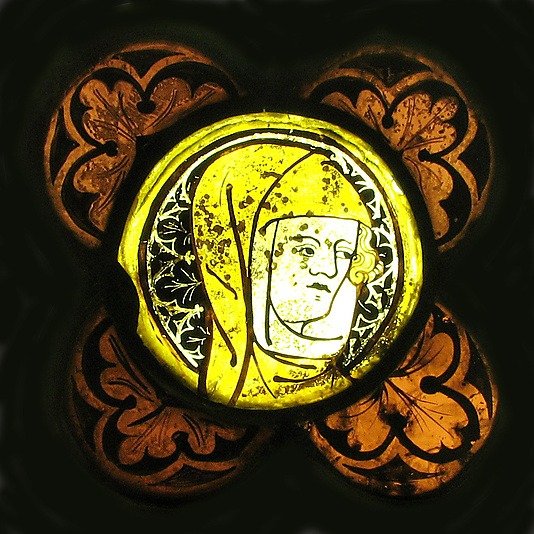
Head of a Woman. Stained Glass. 14th century (Rouen, France) (image: Metropolitan Museum of Art – The Cloisters)

So Erec follows the evil knight to make sure he doesn’t get away all the while hoping to acquire some armor. When the evil knight reaches his castle, Erec finds lodging at an old guy’s house on the outskirts of town. This old guy just so happens to be a retired knight and he has some armor Erec can borrow for his upcoming duel. It also just so happens that this old retired knight’s daughter, Enide, is the fairest of them all.

So, without further ado, here is Chrétien de Troyes’ description of Enide when Erec first sets eyes upon her:

Mout estoit la pucele gente,Que tote i avoit mis s’entente

Nature qui faite l’avoit.

Ele meïsmes s’en estoit

Plus de .vᶜ. fois mervoillie

Comment une soule feïe

Tant bele chose faire sot;

Ne puis tant pener ne se pot

Qu’ele peüst son examplaire

En nule guise contrefaire

De ceste tesmoingne Nature

C’onques si bele creature

Ne fu veüe en tot le monde.

Por voir vos di qu’Isuez la blonde

N’ot tant les crins sors et luisanz

Que a cesti ne fust neanz.

Plus ot que n’est la flor de lis,

Cler et blanc le front et le vis.

Sor la blanchor, par grant merveille,

D’une color fresche et mermeille,

Que Nature li ot done,

Estoit sa face enluminee.

Li huil si grant clarté rendoient

Que deus estoiles resembloient.

Onques Dex ne sot faire miauz

Le nes, la boche, ne les iauz.

Que diroie de sa beauté?

Ce fu cele por verité

Qui fu faite por esgarder,

Qu’en li se peüst on mirer

Ausi con en un mireour. (v. 411-41)[1]


The maid was charming,in sooth, for Nature had used

all of her skill in forming her.

Nature herself had marveled

more than five hundred times

how upon this one occasion

she had succeeded in creating

such a perfect thing.

Never again could she so strive successfully to reproduce her pattern.

Nature bears witness

concerning her that never was

so fair a creature seen in all the world.

In truth I say that never did Iseult the Fair have such radiant golden tresses that she could be compared to this maiden.

The complexion of her forehead and face was clearer and more delicate than the lily.

But with wondrous art her face

with all its delicate pallor

was suffused with a fresh crimson

which Nature had bestowed upon her.

Her eyes were so bright

that they seemed like two stars.

God never formed better nose,

mouth and eyes.

What shall I say of her beauty?

In sooth, she was made

to be looked at;

for in her one could have seen himself

as in a mirror. (6)[2]


[1] Reference to Chrétien de Troyes in Old French from Erec et Enide, Ed. Jean-Marie Fritz (Paris, 1992).

[2] Reference to Chrétien de Troyes in Modern English from Chrétien de Troyes: Arthurian Romances, Trans. W.W. Comfort (London, 1963).

One thing that always makes me cringe is reading a medieval English poem with anti-Jewish[1] sentiment. I sink into my chair, hoping that no one can tell that I’m reading it. Anti-Jewish sentiment is uncomfortably common in medieval literature and it’s something you’ll encounter more often than you’d like if you read a lot of it and “to exclude these references would be desirable but… it would be unhistorical: for medieval Christian writers, Synagogue was the blindfold girl with the broken staff, prominently sculpted on their cathedrals.”[2]

We know that we should try to read medieval literature in as close as we can get to its historical and cultural context, but let’s be serious: If I organized a reading of medieval poetry at a local library or café and recited a tale of a little innocent boy, who, while whistling a tune of praise to the Virgin Mary through a Jewish neighborhood had his throat slit by Jews and dropped in a latrine to die – I’d feel compelled to explain the reasoning behind my selection unless I had the sweet and obnoxious naivety of Borat Sagdiyev.

Image

Borat Sagdiyev demonstrates the “Jew Claw” in his guide to “American Hobbies” from Da Ali G Show Season 2: Episode 9 “Politics” (Original airdate: March 7, 2003). Copyright 2003 Talkback, Freemantle Media, HBO, Channel 4.(image: http://www.youtube.com/watch?v=a_GOmXt-DKg)

Depending on how politically correct the audience was, I might even feel obligated to offer some sort of apology for the reading. But let’s get back to how I cringe when I see anti-Jewish material in medieval poetry. I read a lot of Chaucer. 

Most of the cringing I get from Chaucer comes from his corny jokes, but sadly, his works are not without its own anti-Jewish material – though to be fair this material says more about the charaters being portrayed and parodied in his work than his own personal views.

In his Canterbury Tales we have “The Prioress’s tale” which is about an innocent little boy being viciously murdered and cast into a latrine by some evil Jews. It could easily be interpreted on the surface level to both a 14th century audience and a modern one as nothing but a tirade against Jews.

So here we go. If you’ve read this far, you probably won’t be offended – and if you are, well, it’s your own damn fault.

Drama builds as the little boy doesn’t return home from school. His mother asks if anyone has seen her darling little boy. To her horror, she discovers that he was last seen in the Jewish ghetto. 

A searching party is gathered and the mangled, bloody body of the boy is found.

It’s every parent’s worst nightmare.

But wait! Something miraculous happens.

Though the boy’s throat is cut, he’s singing a song of praise to the Virgin Mary. When he’s asked by a priest how this could be, the boy tells him that the Virgin Mary herself came to him and put a grain under his tongue which brought him back to life. The priest removes the grain from the boy’s mouth, the boy’s body stops singing and his soul ascends to heaven. 

What a miraculous sight! 

The Jews are rounded up and executed without a trial. Everyone lives happily ever after!

Why would Chaucer write something like this? Chaucer wrote Canterbury Tales, but within the tales themselves, he is only the narrator and a quiet narrator at that. 

We should approach each pilgrim’s story as verbatim quotes from the pilgrims themselves into a reporter’s microphone. 

Since Chaucer is mostly a silent observer anyway, he’s more like a quiet documentary filmmaker than an eye-witness news reporter. 

Of course, there is the occasional aside, and the audience sees its fair share of boom mics, but with the exception of his commentary in the General Prologue, he resigns himself to the role of a quiet cameraman documenting the goings ons of an English pilgrimage to Canterbury. 

Actually, he’s more akin to a producer of a reality show. Well, not really… but let’s consider it. If the prioress character hates Jews, it doesn’t mean that Chaucer shares this sentiment. I mean, of course he kept the camera rolling and put it in the show – but people like trash TV. They seem to have watched it as much in the 14th century as we do today. 

So, if a character on Chaucer’s reality show spews anti-Jewish rhetoric, it’s their voice – not his. Right?

The Prioress tells us this tale of the Virgin Mary’s youngest holy martyr going against the big bad wolves of Jerusalem. The clouds part, the community comes together, kills the evil doers and praises their holy Mother. Problem is, the story isn’t very nice for today’s audience because its bloodthirsty villains are Jewish people.

A modern educated audience understands that these villains are distorted caricatures of Jewish people, but adding all of those disclaimers interferes with the flow of the narrative.

The Prioress starts her tale by describing the boy. He’s an adorable “litel book lernynge,” studying his “prymer” in school minding his own business when, suddenly, he hears a beautiful song. It’s not just any song, it is Alma Redemptoris.

 He absolutely loves it. It’s in Latin and he doesn’t know what it’s about, but he knows that it is something special so he tries to learn to sing it himself even though it’s a song intended for the older boys.

One day, he asks an older boy what the words mean and if he’d help him learn it.

The older boy tells him that it is about the glory of the Virgin Mary. He teaches him how to sing it in secret with the little boy knowing full well that if he studies the big boys’ “antiphoner” he may punished for falling behind in his own “prymer” studies.

Once the boy learns this beautiful song, he finds that it brings him such joy that he just can’t stop singing it!

This litel child, as he cam to and fro,

Ful murily than wolde he synge and crie

O Al redemptoris everemo.

The swetnesse hath his herte perced so

Of Cristes mooder that, to hire to preye,

He kan nat stynte of snyging by the weye. (1742-47)

The Prioress’s description of the joy in the boy’s heart is full of saccharine. Imagine this boy skipping for joy – or better yet, in the backseat of a car singing John Jacob Jingleheimer Schmidt for five hours straight. We can see how this could be a little irritating for people, but to the prioress this precious little boy could do no wrong. 

He wanders into a Jewish ghetto and the Jews who live there sure are evil. In fact, they are the limbs of Satan. Don’t believe me? The Prioress clearly considers the Jews in the story to be limbs of Satan because she has Satan himself appear in the story. It’s like saying that the Jews fail to consider Jesus Christ God not because they worship the God of the Old Testament or disagree that Jesus is the new prophet or Messiah, but because they worship Satan instead.

Well, as you probably guess, Satan appears and orders the Jews (Hebrayk peple) to kill the boy and they follow his orders.

Image

“for medieval Christian writers, Synagogue was the blindfold girl with the broken staff, prominently sculpted on their cathedrals” Synagogue (Old Law) 20th century copy on Strasbourg Cathedral. photo: Aidan McRae Thomson (detail) http://www.flickr.com/photos/amthomson/4996417314/in/photostream/ see also (New Law) http://www.flickr.com/photos/amthomson/4996417778/in/photostream/ and the originals in Musée de l’Oeuvre Notre Dame: http://en.wikipedia.org/wiki/Ecclesia_and_Synagoga

How can they find it in their hearts to kill a boy walking through their ghetto? Don’t be silly! Everyone, including the Prioress, knows that Jews have Satan’s wasp nest for a heart! 

As shocking as these anti-Jewish statements seem to us today, there is such hyperbole and ridiculousness to them that, knowing Chaucer’s wit and appreciation for secular classics, this passage should be read as satire of anti-Jewish sentiments held by the many so-called Christians of his day:

Oure firste foo, the serpent Sathanas,

That hath in Jues herte his waspes nest,

Up swal, and seide, “O Hebrayk peple,

allas!

Is this to yow a thing that is honest,

That swich a boy shal walken as hym lest

In youre despit, and synge of swich sentence,

Which is again youre laws of reverence?”

Fro thennes forth the Jues han conspired

This innocent out of this world to chace,

An homicide thereto han they hyred,

That in an aleye hadde a privee place;

And as the child gan forby for to pace,

This crused Jew hym hente, and heeld hym

faste,

And kitte his throte, and in a pit hym caste. (1748-1761)

Another thing, how did the boy get into this situation? Did he really just wander into the Jewish ghetto? Of course not! He went there. During the middle ages, the Jewish ghetto wasn’t just “the bad side of town” that a little Christian boy crossed through each day on his way to school. 

During the middle ages, the Jews of Western Europe lived in walled ghettos with strict curfews that required them to be locked-in during the night and on Sundays.[3] This little boy walking through the Jewish ghetto is like Jesus marching into the Temple of Jerusalem and knocking over the money changing tables and pigeon coops:

And Jhesus entride in to the temple of God, and castide out of the temple alle that bouƺten and solden; and he turned vpsedoun the bordis of chaungeris, and the chayeris of men that solden culueris. And he seith to hem, It is writun, myn hous schal be clepid an hous of preier; but ƺe han maad it a denne of theues. (Matthew 21:12-13)[4]

It’s a different sort of boldness. It’s a bold innocence. It’s an action that is difficult for people to criticize.

How can you hold a little boy responsible for his actions – especially when he’s singing praise for his Heavenly, matchless maiden mother? 

The boy confronts medieval Christian society’s perceived enemies of Christ with innocent sweetness. Well, isn’t that cute!

Either the boy doesn’t know what he’s doing because he’s just beaming with the joy of the Virgin Mary or he knows exactly what he’s doing: marching bravely into the Valley of Death as Christ’s newest and youngest soldier. 

Whichever one you choose, it’s still blind faith. 

So this leads us to Chaucer’s question: Well, if the Jew represents the blind girl with the broken staff, and this boy is blindly walking into a Jewish ghetto spreading his own recently acquired blind faith, well then, what is blind faith?

Don’t know how to respond? That’s ok, the audience in Canterbury Tales doesn’t know how to respond either. There’s a sobering silence over the entire party.


[1] This article follows Esther Zago’s example of using the term “anti-Jewish” instead of “anti-Semetic” to describe the attitudes toward Jews in “The Prioress’ Tale” because anti-Semetic is a “19th century term which shifted the focus of the entire Jewish question from religion to race.” A more detailed explanation of her purpose in using the term “anti-Jewish” and her succinct placement of the Jews in 14th century Britain into historical perspective can be found in her “Reflections on Chaucer’s ‘The Prioress’s Tale’” http://ir.uiowa.edu/cgi/viewcontent.cgi?article=1661&context=mff

[2] Brian Stone, Medieval English Verse (Middlesex, 1964), 35.

[3] George Robinson, Essential Judaism (New York, 2000), 468.

[4] Wyclif, John. Matthew 21:12-13 in Forhsall and Madden, eds. The New Testament in English According to the version by John Wycliffe, about 1380, and revised by John Purvey about 1388. (London: Oxford, 1879).

Apollo XI and the Saturn V moon rocket (image: Bruce Weaver)

I was reading a particularly amusing post from Christopher Knowles today about why he Hates Saturn and this part especially reminded me once again that we still describe things in similar terms as medieval storytellers:

Either way, when Saturn was transiting through Cancer it was kind of like living with a physically-abusive alcoholic; you never knew what kind of nightmare was going to pop up next. I ended up in the hospital quite a few times and things just generally went to hell. This recent Saturn in Libra thing was more like walking around with fifty pound sacks of wet sand on my back. Everything just ground down, like driving a car with four flat tires. Of course, the daily burden of managing a severe chronic pain condition doesn’t make any of this any easier.[1]

Referencing Saturn’s position (or influence) among the planets is a cliché that medieval storytellers use to explain things going amiss.

Whenever a medieval storyteller needs to say that something went wrong, he can simply point to Saturn’s involvement in the situation. It often serves a comic purpose too (think narrator in an Ed wood movie: “all was pleasant until Saturn appeared …”).

It’s a little more complex than that of course, and life and death situations for man on earth mirror petty
disputes among the gods and vice versa.

A good example of Saturn being used this way in 14th century English literature is in part One of Chaucer’s Knight’s Tale [Saturn is mentioned several times in this story following and affecting the action, but first when Palamoun is consoling his friend Arcite while he curses his imprisonment just after he casts his eyes on the beautiful Emelye who will become the cause of a great dispute with his friend which will tragically end in death]:

Cosyn myn, what eyleth thee

That art so pale and deedly on to see?

Why cridestow? Who hath thee doon offense?

For Goddes love, taak al in pacience

Oure prisoun, for it may noon oother be.

Fortune hath yeven us this adversitee.

Som wikke aspect or disposicioun

Of Saturne, by sum constellacioun,

Hath yeven us this, although we hadde it sworn:

So stood the hevene whan that we were born.

We moste endure it; this is the short and playn. (1081-91) [2]


Did you read your horoscope today?


[1] Christopher Knowles, The Secret Sun: Why I Hate Saturn http://www.secretsun.blogspot.com/2012/10/why-i-hate-saturn.html

[2] The Knight’s Tale in Middle English from Chaucer’s Major Poetry, Ed. Albert C. Baugh (New York, 1963).

Nothing quite gets the blood flowing, nay, gushing and splattering, like a medieval storyteller describing life (and especially death) on the battlefield. The best of them, so beautifully vivid and precise are always garnished with the right touch of hyperbole – were they wading in a river of blood up to their ankles or was it up to their knees?

Wink Barnes (played by Ned Eisenberg) is delighted by the gruesome traffic safety film “Blood Flows Red on the Highway” in the 1985 movie Moving Violations (image: copyright 1985 20th Century Fox / SLM Production Group)

Today’s medieval bloodfest comes from Burton Raffel’s translation/rendering of the Middle High German 13th century epic poem Das Nibelungenlied.

Sifried (or Sigurd from the Völsung Legends) left the Netherlands for Burgundy to court princess Krimhild. He hung around King Gunter’s hall for a while, spinning his wheels, when, sure enough, some excitement finally came along. The Danish king Ludegast, and the Saxon lord Ludiger joined forces and threatened to destroy the Burgundians unless they agreed to pay them an obscene amount of money. With everyone in the hall shaking in their boots, Sifried smiled at the chance to show his host (and his prospective bride-to-be – via accounts from messengers) his favorite hobby – hacking and slashing!


This passage describes Sifried meeting King Ludegast on the battlefield:


Sifried struck so hard     against his shining armor

that iron was broken through,      a blow that only brass

-if that-might have blocked,        and blood spattered the grass

and Ludegast was lost,     suffering sharp, deadly harm.[1]


This next one shows us exactly what frame of mind Sifried was in when he spotted the Saxon lord Ludiger:


None of the Rhineland men    were ever seen behind him.

rivers of red ran             from his blade in a bloody line,

for where his sword came down      helmets cracked with the blow.

And then he saw Ludiger,      marshaling men, row after row.[2]


And finally, here is a nice wide angle shot of Sifried convincing King Ludiger to surrender:


The two princes battled       on. Gashes sprung

on helmets everywhere,            shields showed gouges long

and wide, still held in heroes’          hands. And all along

the blood of many men’s bodies             came raining down on the thirsty ground.[3]


[1] Das Nibelungenlied, Trans. Burton Raffel (New Haven, 2006), verse 188, p.28

[2] Das Nibelungenlied, verse 205, p.31

[3] Das Nibelungenlied, verse 212, p.32

There are many fantasy novels set in fictional medieval worlds that share very little of the medieval worldview with us. One barely needs to remove a single suit of shining armor to reveal that most fantasy stories have very little in common with the medieval world besides wardrobe. I’m not saying that people who write fantasy need to make it clear in their text that they can distinguish Thomas Malory from Chrétien de Troyes or Beowulf from Sigurd, but I love it when a fantasy author borrows a cliché, a custom, an object, a theme, or a philosophy from a medieval text and fits it snugly into his own story, effectively evoking medieval essence without disturbing the modern narrative. After all, that’s what medieval storytelling is all about and it’s a tradition that should continue to thrive. An example of such a borrowing that achieves this “medieval essence” can be found in Lloyd Alexander’s Chronicles of Prydain. Alexander carried a symbol from a popular 14th century English poem, simplified it, yet kept the kernel of its strong positive moral message, and placed it in his own story for a modern popular audience

The Chronicles of Prydain is a children’s fantasy adventure series set in a medieval imaginary world. Its easy dialogue, storybook humor, caricatures of Tolkien characters, and often predictable story grant it entrance to the children’s fantasy genre, but Alexander added a special depth to his narrative with simple, yet rich glimpses into the wisdom of the medieval worldview.

One such example occurs In The Black Cauldron, the second book of Chronicles of Prydain. In the story, the young hero Taran is on a quest to rescue a magic cauldron from the clutches of an evil lord who uses the anciently powerful object as a sort of weapon of mass destruction involving zombies. During his quest, Adaon, the son of a chief bard, presents Taran with a brooch. Taran discovers that this brooch gives him dream visions with glimpses of future events. Piecing these glimpses of future events together aids him in his quest to save Prydain, the imaginary world where the story is set. In addition to this magical quality, the brooch is decorated with a symbol that represents a powerful system of virtues that is very similar both in concept and appearance to the Pentangle on Gawain’s shield in Sir Gawain and the Green Knight.

Since Alexander’s readers are quite younger than the 14th century court audiences that enjoyed Sir Gawain and the Green Knight, he created a symbol that is less complex than Gawain’s Pentangle. Although the brooch’s symbol is less complex than the Pentangle in terms of the number of virtues it represents and it lacks Christian iconography, it retains and effectively communicates the same fundamental concept of its 14th century ancestor.

As Taran & company head for the Marshes of Morva, the bard Fflewddur takes a closer look at the brooch which is fastened to Taran’s neck. After examining it, he reveals to Taran that, “it bears the bardic symbol – those three lines there, like a sort of arrowhead.”[1] Fflewddur explains that the three lines symbolize respectively, “knowledge, truth, and love.”[2] Fflewddur then comments on the value and rarity of these virtues, “I sometimes think it’s hard enough to find any one of them, even separately. Put them all together and you have something very powerful indeed.”[3]

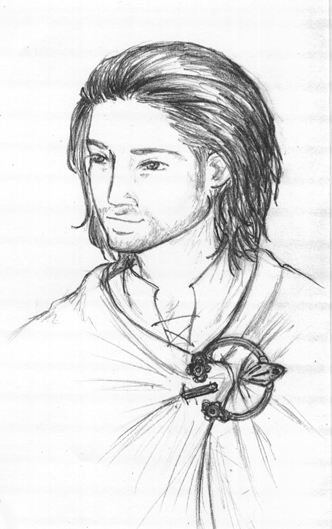
Portrait of Adaon. Notice how the artist depicts the bardic symbol “three lines there, like a sort of arrowhead” on Taran’s brooch. image: http://oboe-wan.deviantart.com/art/Adaon-109317843

The Pentangle painted in pure gold on Gawain’s shield represents “something very powerful” as well. The narrator (often referred to by medieval scholars as the Gawain poet or the Pearl poet) of Sir Gawain and the Green Knight uses forty two lines of his poem to provide his audience with a detailed description of the system of balanced virtues that the Pentangle symbolizes.

The Gawain poet narrator describes the Pentangle as a system of virtues organized by five sets of five. Each point of the star symbolizes five different things, and each of these five things corresponds symbiotically with the other sets of five. To briefly enumerate the five equal layers of the system, the five points represent the five wits, the five fingers of Gawain’s hand, the five wounds Christ suffered on the cross, the five joys that the Virgin Mary had in her child, and the five pure virtues: frankness, fellowship, cleanness, courtesy, and compassion.

The Gawain poet then tells the audience that these attributes are interconnected:

 Now alle these five sythez, for soothe, were fetled on this knyght,

And uchone halched in other, that non ende hade,

And fyched upon five poyntez, that fayld never,

Ne samned never in no side, ne sundred nouther,

Withouten ende at any noke I oquere fynde,

Whereever the gomen bygan, or glod to an ende. (Fitt 2, v. 656-61)[4]

 Now truly, all these five groups were embodied in that knight,

Each one linked to the others in an endless design,

Based upon five points that was never unfinished,

Not uniting in one line nor separating either;

Without ending anywhere at any point that I find,

No matter where the line began or ran to an end. (Part 2, v. 656-61)[5]

Detail of lines 656-61 of Sir Gawain and the Green Knight as they appear in MS Cotton Nero A.x. (art. 3). c. 1400 British Library / University of Calgary, Libraries and Cultural Resources. image: http://gawain.ucalgary.ca/

Now, keeping a modern audience’s attention while a five point system which is actually a twenty-five point system is explained in detail would be an incredible feat for today’s storyteller and would require a patient, polite, and engaged audience. A medieval court audience, however, would be quite familiar with the concept of this type of system of organization and would probably be receptive to an even more complex one.

An example of a work where the narrator shares a complex system through which man may achieve spiritual, dietary, moral, and physical balance among the elements (or in Gawain’s case, reaching and maintaining a state of purity) that a medieval court audience would be familiar with is the Secreta Secretorum. The Secreta Secretorum was one of the most widely read books in 14th century England and France. It “circulated freely in court circles”[6] and was, as Terry Jones puts it, “de rigueur on any [medieval] thinking person’s reading list.”[7] It was a type of advice text that scholars call “medieval Mirrors for Princes.”[8] Secreta Secretorum is presented as material gleaned from letters sent between Aristotle and his student Alexander the Great while Alexander campaigned in Persia. Aristotle organizes various disciplines of study and states of the body into systems of four and describes how these four components correspond both to each other and collectively.

He divides Astronomy, for example, into four components: the position of the stars among themselves, the constellations and their position as it relates to the sun, the quality and the moving of the celestial dome, and the degrees of the rising of the constellations that reside in the moon’s celestial band (zodiac constellations).

Nowe to oure first mater and purpose, it is to wite, In the ordinaunce of the sterres; In disposicioun of ϸe signes and alyenyng and mevyng fro ϸe sonne; and this party is called Astronomye; that other part is of qualitees, and also for to knowe the mevyng of ϸe firmament, and the dgrees of ϸe risyng of ϸe signes that are vndir the firmament of ϸe mone, and this is the most worthi part of Astronomye, for ϸerin is the cheef knowyng of ϸat science. (Cap. 28 ll. 26-34)[9]

Image of an early 15th century English Medical Treatise HM 19079. Notice how the article has a heading and notes in the margin.  Huntington Library. image: http://sunsite3.berkeley.edu/hehweb/toc.html (Compare to image below of print transcription of Secreta Secretorum)

Detail of transcription of Cap. 28 from MS. Reg. 18 A. vij. B.M. from Three Prose Versions of the Secreta Secretorum. Vol I Ed. Robert Steel (London, 1898) Image: http://books.google.com/

To make an Astronomical conclusion one must consider all four of these factors, however, data from one category may be used with data from a category of another discipline when answering a question that crosses disciplines. Of course, according to that worldview, to answer any question effectively, it was necessary to cross disciplines – ideally several times. To make it possible to compare the data among the other disciplines, they too were organized into basic divisions of four. They were each thought to influence each other. Aristotle divides the human body into four basic parts: the head, the chest, the stomach, and the genitals. He also organizes humors (tempers or dispositions), elements,[10] and seasons[11] into four qualities. Not every system or exemplum in the text is exclusively organized in units of four, but so many of them are that it seems to be Aristotle’s favorite method of outlining complicated scientific ideas.

Since disease in the medieval world was seen as an imbalance in the way the body and mind interacted with the physical world, symbiotic relationships were considered among the body and the physical world for both the diagnosis and treatment of disease. For example, during spring, Aristotle recommends that one should eat chicken, goat, bitter greens, and milk. It is also the ideal time to “flush out” the toxins that accumulate in the body during winter by inducing sweat, bathing, bloodletting, and eating foods with laxative properties:

In this tyme shulde chykenys be ete, and kydes and eggis, soure letuse ϸat men calle carlokis, and getis mylke. In this tyme is best to lete blood, for onys than is bettir than thre tymes an other tyme ; and it is good to travayle and to haue thi wombe soluble, and than it is good to swete, to bathe, and to goo, and to ete things that are laxatijf, for alle thing that amendith bi digestioun or by blood letyng it shalle sone retorne and amend in this prime temps .i. veer. ” (Cap. 43 ll. 23-30)[12]

While, during winter he recommends one eat hot meats such as chicken and mutton, figs, nuts, and red wine. He also advises to refrain from laxative foods and bloodletting during winter unless it is absolutely necessary.[13]

The Gawain poet doesn’t provide a treatise on medieval medicine and he certainly doesn’t tell us how eating a certain type of food will affect Gawain’s stomach based on his complexion and temper, the constellations as they relate to the moon, and the season. He does, however, include a detailed description of a system (either historical, legendary, or by personal creation) by which one may achieve moral purity.

It is typical of a medieval poet to impart a moral message to a story and one of the methods the Gawain poet uses is describing the meaning of the Pentangle on Gawain’s shield.[14] Since Sir Gawain and the Green Knight is a tale about a knight from King Arthur’s court who unknowingly agrees to have his virtue tested, the Pentangle’s description appears as Gawain is gearing up to leave King Arthur’s court to meet the Green Knight to receive his long-awaited return blow. The description of Gawain’s shield tells the medieval audience that Gawain will be tested.

Picture of Sir Gawain and the Pentangle from the video The Quest for Sir Gawain and the Green Knight. image: https://www.youtube.com/watch?v=-nAd6fffVvs

The brooch in The Black Cauldron tells the audience, in the same way, that Taran will be tested. Though Gawain isn’t forced to wager with his shield in the same way Taran is with his brooch in the Marshas of Morva, the brooch, like Gawain’s shield, offers protection. Where a shield would protect someone from physical harm in a combat situation, the brooch protects Taran by giving him dream visions that arguably save both his life and his quest, but more importantly, they both serve as a reminder to rely on a system of virtue to guide them through life much the teachings of Secreta Secrtorum are meant to do for a king ruling a state. Simplifying the system by presenting fewer virtues and choosing not to give the three lines multiple layers like the Gawain poet did with the Pentangle, Alexander succeeded in using medieval literary devices to promote a positive moral message within a children’s fantasy story.

The narrator poet of Sir Gawain and the Green Knight describes the significance of the pentangle painted on Gawain’s shield directly to the audience as part of a character portrait. It is typical in medieval narrative poetry for the narrator to give a physical description of characters and to use their clothing and objects they carry with them to give the audience details about their estate (or social class) and personalities. Medieval scholars call this a character portrait. One of the most popular examples of a medieval style character portrait is when Chaucer describes each of the pilgrims during the General Prologue of his Canterbury Tales.

Character portraits can vary in length and they can sometimes give the audience an idea of the poet’s moral or political agenda. In the Gawain poet’s case, we see that he thinks it is very important for the audience to understand (or to know that he understands) the Pentangle’s system of virtues because it takes up half of Gawain’s character portrait. While Alexander used a symbol that evokes a similar values system as the Pentangle, the method he uses to introduce it to the story is different from the one used by the Gawain poet. Alexander describes its symbolism to the audience in a modern way rather than a medieval way.

While the Gawain poet used the narrator’s voice providing a medieval character portrait to describe the Pentangle, Alexander used dialogue by having a character with some knowledge of bardic lore describe the significance of the brooch’s symbol to Taran. Having Fflewddur explain the significance of the brooch to Taran is similar to Aristotle’s method of teaching in the Secreta Secretorum in that you have an older, wiser, and somewhat quirky character providing moral guidance to a young character in an important leadership position.

Though the focus of the Secreta Secretorum as an advice text is on physical, political, and economic survival, Aristotle imparts a system of virtue in his teaching. One gets the sense that “being good” is a fundamental ingredient in the system of good governance outlined in this treatise.

Occasionally, Aristole is very direct in passages like this one where he identifies envy as the mother of lying and hatred as the root of all vices, “enuye is neuyr without lesyngis, the which is roote and mater of alle vicis. Envye engedrith yville spekyng, and of yville speche cometh hatred.” (Cap. 8 ll. 6-9)[15] To balance his sermon on the root of vice, Aristotle later points out that truth brings good faith, justice, friendship, great renown for the leader both at home and abroad, promotes the creation of reasonable laws, and fosters a positive sense of community.[16] These are direct examples, but the tone and underlying philosophy of the text implies that virtue is a necessary component of success.

The teachings in the Secreta Secretorum vary in length. For example, instruction on the proper way to sleep[17] is 27 lines while advice on what sort of clothing a king should wear[18] is only 11 lines, but “each exemplum is short enough to be taken in all at once, aiming for a flash of insight or identification.”[19] Though Aristotle doesn’t use a symbol like Lloyd Alexander and the Gawain poet do, the answers to the great mysteries of life that are explained in the Secreta Secretorum can be summarized in these key points: man should seek harmony by guarding himself from impulsive behavior, stay connected with nature and use his resources in moderation according to its cycles, be kind to his fellow man, and value truth above all. Like Gawain’s Pentangle and Taran’s brooch, the teachings in the Secreta Secretorum also suggest that Alexander the Great will be tested as a ruler.

The physical symbols of Taran’s brooch and Gawain’s Pentangle appear different in many ways on the surface (one is “a sort of arrowhead” and the other is a five pointed star) and Aristotle’s method aims to achieve a “flash of insight” without the use of a physical symbol. Each author incorporates different imagery; the Gawain poet uses Christian imagery while Alexander does not. Alexander doesn’t mention a concept of God at all and while the medieval manuscript of Aristotle’s Secreta Secretorum referenced in this article often mentions God, the scribe who copied it did not include Christ’s name a single time in the text.

These three authors do not use the same number of virtues in their respective values systems, and these systems are introduced to the stories in different ways. The incorporation of a values system in these texts suggests that the Gawain poet, Lloyd Alexander, and Aristotle all agree that every hero or person in a position of power must have a code or values system to guide him. By looking at the different ways values systems appear in stories and comparing the core of the respective values systems they illustrate, we realize this: the symbol we carry with us on our quest is not as important as our will to practice it every step along the way.


[1] Lloyd Alexander, The Black Cauldron (Holt, Rine and Winston: New York, 1965), 117.

[2] Lloyd Alexander, 117.

[3]Lloyd Alexander, 117.

[4] Sir Gawain and The Green Knight: Middle English Text with facing Translation, Ed., Trans. James Winny (Peterborough, 1992).

[5] Sir Gawain and The Green Knight

[6] Katharine Breen, “A Different Kind of Book for Richard’s Sake: MS Bodley 581 as Ethical Handbook,” The Chaucer Review 45.2 (2010): 131.

[7] Terry Jones, Who Murdered Chaucer? (New York, 2004), 50.

[8] Katharine Breen, 120.

[9] The Secrete of Secretes. Translated from the French (MS. Reg. 18 A. vij. B.M.) from Three Prose Versions of the Secreta Secretorum. Vol I Ed. Robert Steel (London, 1898), 21.

[10] The Secrete of Secretes, 22.

[11] The Secrete of Secretes, 27-29.

[12] The Secrete of Secretes, 27.

[13] The Secrete of Secretes, 29.

[14] Though this article only describes the Pentangle that appears on the front of Gawain’s shield, the interior of the shield is painted with a portrait of the Virgin Mary.

[15] The Secrete of Secretes, 10.

[16] The Secrete of Secretes, (Cap. 8 ll. 16-27) 10.

[17] The Secrete of Secretes, (Cap. 39) 25.

[18] The Secrete of Secretes, (Cap. 13) 12.

[19] Katharine Breen, 132.